Quick answer
Sometimes, but rarely on the value you hope for. A lender looks at what the property is worth today, as it stands, and a partly built structure is often worth little more than the land beneath it. We don't fund construction draws, so the usual answer is a loan against the site at its as-is value, or against another completed property you own, with completion funded separately.
Key points
- Lenders assess incomplete property on its as-is value, not the on-completion figure in your feasibility
- A half-finished structure can add little to land value, and sometimes subtracts from it
- We don't make progress draws or lend on the build itself
- Completed property you already own is usually the cleanest security for completion costs
- If your builder has failed, check home building cover before borrowing to fill the gap
Half-built property is one of the most common things owners ask us to lend against, and one of the most misunderstood. The feasibility says the finished townhouses will be worth $3.2m. The bank has spent $1.4m. Surely there is room for another $400k?
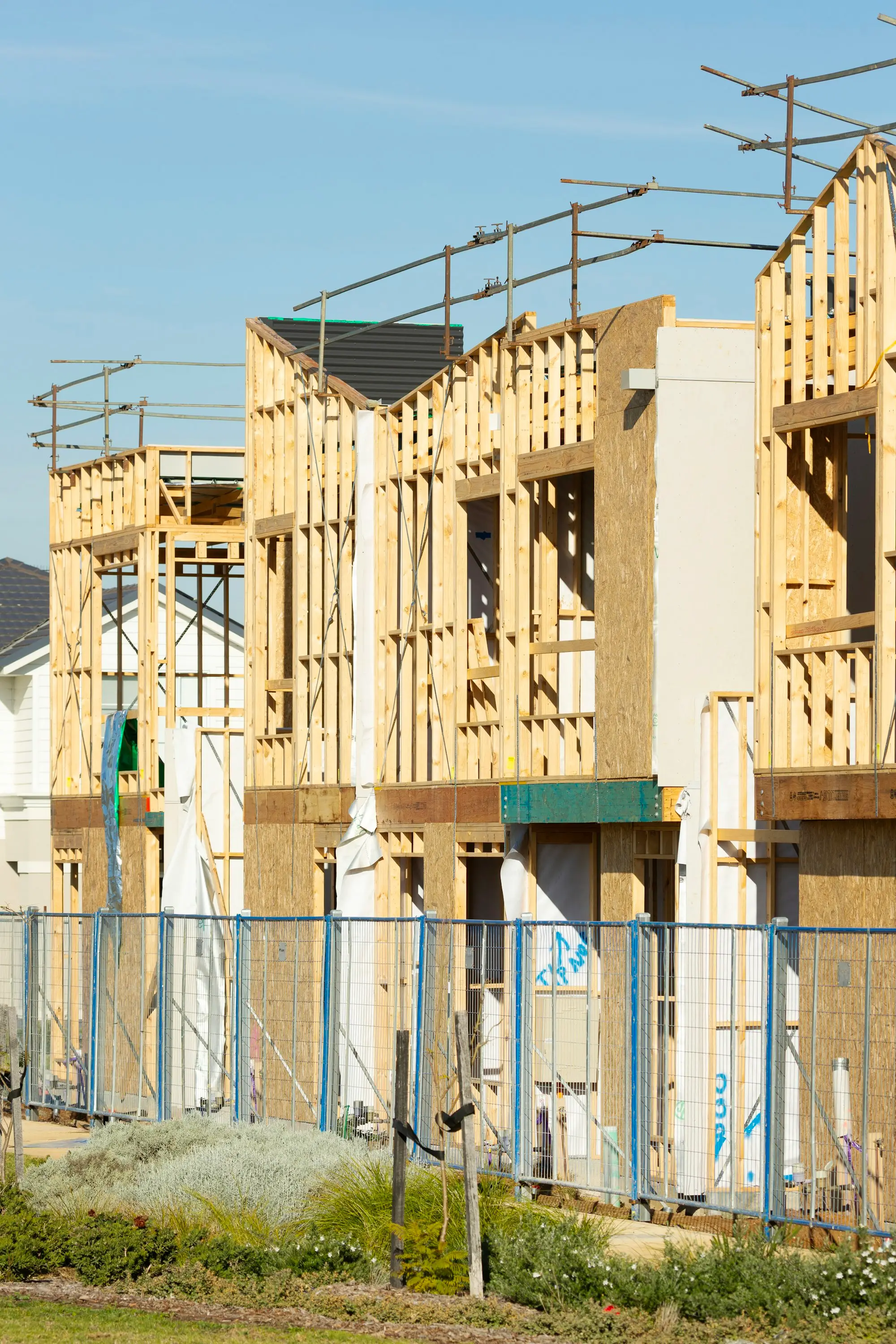
The honest answer is that a lender doesn’t lend on what a building will be worth when it is finished. It lends on what the property would sell for today, as it stands, if things went wrong. And a slab, a frame and a roof that isn’t quite on are worth far less to a buyer than they cost to put there.
That doesn’t mean you’re stuck. It means the loan usually has to be built around something other than the half-finished building. Here is how to think it through.
How does a lender value a property that isn’t finished?
A lender asks a simple question: if this loan had to be repaid by selling the security, what would a buyer pay, and how long would it take?
For a completed building, that is straightforward. For an incomplete one, the buyer has to take on the cost and risk of finishing it: new contracts, possible defects in work already done, approvals that may need updating, and insurance during the remaining build. Buyers price that risk heavily. The result is that a partly built property is often valued close to the land underneath it, with only modest credit for the work in place.
We assess value ourselves rather than ordering a sworn valuation, so there is nothing for you to arrange or pay for. But the principle is the same: we look at what’s there today, not the on-completion figure in your feasibility.
| Stage of build | How it tends to look to a lender |
|---|---|
| Cleared site, approvals in place | Valued as land, with some credit for useful approvals |
| Slab or footings only | Usually close to land value; the work may not add much |
| Frame up, not locked up | Exposed to weather and theft; buyers discount it heavily |
| Lock-up, fit-out unfinished | More credit, but completion costs and sign-off still loom |
| Complete with final sign-off | Valued as a finished property: the easiest security of all |
Why don’t private lenders fund the rest of the build?
Building a building is a different kind of lending. A construction lender releases money in stages, checks each stage is done, and holds the site while the value rises. That is a specialist product with its own controls.
We don’t make progress draws or lend on the build itself. Our loans are a single lump sum, secured on property, for business purposes. Where that helps a project is around the build rather than inside it: paying a cost overrun so the construction lender keeps drawing, covering holding costs, or releasing equity from completed property. Our comparison of construction loans and property-secured developer funding sets out which job belongs to which lender.
What are the routes that actually work?
When owners come to us with a half-built property, the answer usually lands in one of three places.
1. Borrow against completed property you already own. This is the cleanest route by far. A first or second mortgage over your factory, your home, an investment unit or finished stock raises a lump sum, and the half-built project doesn’t drive the assessment at all. Our limits are up to 80% of value on residential security and up to 70% on commercial, from $20k to $5m.
2. Borrow against the site at its as-is value. If the site has no construction lender on it and real value as land, it can secure a loan by itself. Expect the amount to reflect land value, not the investment in the structure. Our page on vacant land loans explains how land is assessed.
3. Fund a specific gap so the main lender keeps going. If a construction lender has paused because the budget has blown out, a lump sum against other property can pay the difference. That is what cost overrun funding is for.
If one of these sounds like your situation, a quick enquiry will tell you which route fits before you spend time on paperwork.
What if your builder has collapsed?
A builder going under mid-job is the most common reason a property ends up half built. Before you borrow to fill the gap, check what insurance may pay.
In NSW, home building compensation cover is required for residential work over $20,000, and SIRA says it can respond to incomplete work and lost deposits or progress payments when the builder becomes insolvent, disappears or dies, with cover up to $340,000. In Victoria, Consumer Affairs Victoria explains that older domestic building insurance (for work before 1 July 2026) responds to insolvency on jobs over $16,000, though claims for unfinished work may be limited to 20% of the contract price. Since 1 July 2026, the new home warranty insurance applies to major domestic building work over $20,000 on homes of three storeys or less and covers work that is incomplete. Multi-unit and commercial projects often sit outside these schemes.
Whatever insurance doesn’t cover is the shortfall a loan would need to fund. Our guide on what to do when your builder collapses covers the order of steps.
Illustrative example
Illustrative only. The business and figures are invented.
A Toowoomba earthmoving business is building a new workshop and yard on land it owns outright. The steel frame and slab are in, but the steel supplier has demanded payment upfront for the cladding package and the business is $260k short.
The owner first asks whether the half-built workshop can secure the loan. Looked at today, the property is worth roughly what the land and an unclad frame would fetch, about $600k, against well over $900k already spent. A loan against it is possible, but the amount would be limited and the incomplete structure would make any sale slow.
Instead, the owner offers a second mortgage over the family’s investment house, which has plenty of equity behind its bank loan. The lender assesses the house, not the workshop. The $260k lands within days of a complete application, interest is capitalised for the first 6 months so there are no repayments while the build finishes, and once the workshop is complete the business refinances everything into one long-term bank facility.
What should you check before you ask?
A few things make a half-built property conversation much faster:
- Is there a construction lender? If so, get its current statement and any conditions it has set for further draws.
- What approvals are in place? A current development approval and building approval help a site hold value.
- Is the site insured? An incomplete building needs contract works or similar cover. Moneysmart’s guidance on choosing building insurance is a useful checklist for completed property too.
- What will it cost to finish? A builder’s quote for completion tells a lender, and you, how big the real gap is.
- What else do you own? List every property, what it is worth and what is owing. Often the answer is sitting there.
Project stalled? See if you qualify
A half-finished building is stressful. The money is spent, nothing is earning, and every week costs more. The fastest way forward is usually to stop asking the incomplete property to carry the loan and look at what else you own.
Our 60-second loan check asks about the property, what’s owing and what the money is for, and enquiring doesn’t touch your credit score. There’s no credit check at that stage. Your details stay with one direct lender rather than being passed around a panel, and a real specialist looks at your situation and calls you. List every property accurately, including the half-built one and what has been spent, so the first answer is a useful one.
Frequently asked questions
Will a private lender lend on the finished value of my project?
Not as security for a property-secured private loan. We assess what the property is worth today. On-completion values matter to construction lenders, who release funds in stages as work is done; we don't make progress draws.
Is a half-built house or warehouse worth more than the land?
Sometimes, if the work is well advanced, approved and easy to finish. Often not by much. A buyer of an incomplete building has to take on the risk of finishing it, so the market prices the structure cautiously, and early-stage work can even be a cost to remove.
Can I use another property to fund the rest of the build?
Yes, that's the most common route. A first or second mortgage over a completed property you own can raise a lump sum, and that money can be applied to the project as you see fit. The lender's security is the completed property, so the build stage doesn't drive the assessment.
My builder went broke mid-build. Can I borrow to finish?
Possibly, but first check whether home building insurance responds. In NSW, home building compensation cover can pay for incomplete work after a builder becomes insolvent, and Victoria has a similar scheme. Any shortfall can then be funded against completed property you own.
Does the property need an occupation certificate to be used as security?
Not necessarily for vacant land or a site, but an incomplete building without final sign-off is harder to sell, which weighs on how much a lender will advance. A completed, signed-off building is always easier security.
Can a half-built property be a second mortgage?
If a construction lender already holds a first mortgage, a second behind it is unusual, because the construction lender's debt keeps growing with each draw. A completed property elsewhere is normally the better option.